
How to Reduce Design Clashes in Construction Using BIM
Every construction project starts with a basic plan. When you have a proper plan that takes all the important design aspects into account, the project will move forward without any problem. If not, things can fall apart quickly, like -
A duct can end up in the same space as a beam.
Electrical lines can conflict with HVAC systems.
A finished wall can block access that was never coordinated.
If you’ve worked on a job site, you’ve probably seen these issues hamper the project. And you already know how quickly they can turn into delays, frustration, and added costs. So, what’s the solution? Well, you can opt for professional BIM services (BIM - Building Information Modeling).
When you take the help of BIM, you can identify potential design clashes long before crews arrive on-site. If you want to know how exactly that happens, you can keep reading this blog! Let's first start with some basics to understand what could go wrong without BIM Services.
What Are Design Clashes in Construction?
A design clash can happen when two or more building systems try to occupy the same space. Design clashes are usually of three different types -
1. Hard Clashes
These are physical conflicts where two systems occupy the same space
Examples are -
A duct running through a structural beam
A pipe passing directly through a column
Electrical conduits clashing with plumbing lines
These are the easiest to identify and the most expensive to fix if you miss.
2. Soft Clashes
Soft clashes happen when systems don’t leave enough space for safety, access, or maintenance.
Common issues are -
Not enough clearance for equipment servicing
Insufficient space for proper installation
Violations of safety or code requirements
They may not stop construction immediately, but they can cause serious problems later.
3. Workflow (or Time) Clashes
These clashes occur when construction sequencing doesn’t work.
For example -
One trade can’t install until another finishes
Limited site access delays multiple teams
Scheduling conflicts between systems
These don’t show up on drawings, but they can slow down your project!
If you start your construction project and experience these clashes, it can mean more delays, rework, labor, and budget problems. Not exactly what you promised your client!
What Is BIM Clash Detection?
BIM (Building Information Modeling) is a digital process that uses a 3D model to plan, design, and coordinate construction projects. And BIM clash detection is the process of figuring out the potential design conflicts before construction starts on-site.
By using advanced softwares like Navisworks, Revit, Revizti & BIM Track, BIM -
Scans models for physical overlaps
Flags clearance issues
Detects system interferences
Highlights constructability problems
This way, you won’t rely on luck but on the right data for your project.
BIM services help professionals across the construction and building industry who need accurate planning and coordination.
Engineers rely on it to coordinate structural, mechanical, electrical, and plumbing systems.
Contractors and subcontractors use BIM to plan construction, avoid design problems, and reduce rework.
Owners and project managers use it to figure out the progress, costs, and long-term building operations.
How Does BIM Coordination Service Reduce Clashes?
Design clashes often start when project members work separately without any coordination among them. Engineers and contractors often rely on separate drawings and assumptions. And that's exactly how problems usually start.
BIM coordination services can bring everyone onto the same page. Instead of reviewing isolated plans, you can work with a shared 3D model that includes structural and MEP (Mechanical, Electrical, & Plumbing) systems. That’s how it aims to reduce potential clashes during the project
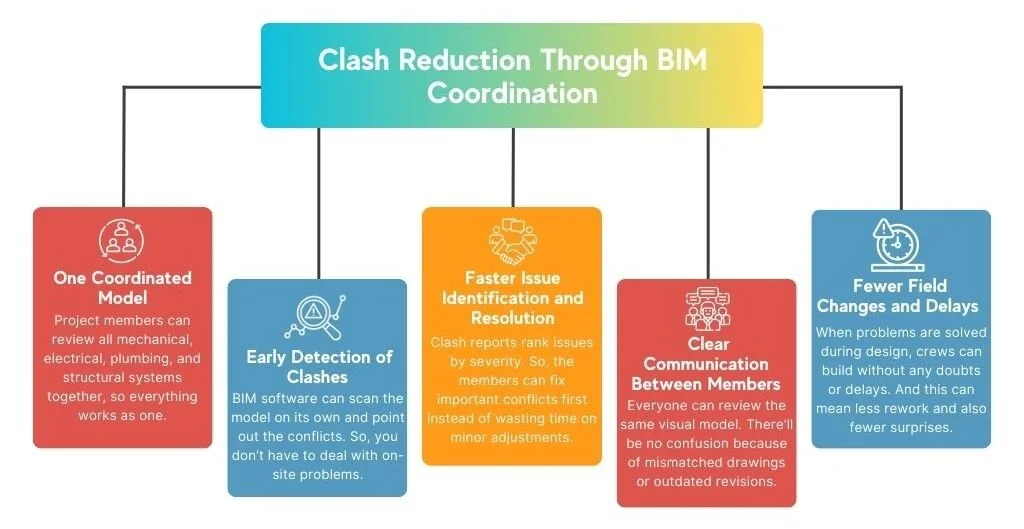
Here’s how BIM coordination works to reduce clashes
1. One Coordinated Model
Project members can review all mechanical, electrical, plumbing, and structural systems together, so everything works as one.
2. Early Detection of Clashes
BIM software can scan the model on its own and point out the conflicts. So, you don’t have to deal with on-site problems.
3. Faster Issue Identification and Resolution
Clash reports rank issues by severity. So, the members can fix important conflicts first instead of wasting time on minor adjustments.
4. Clear Communication Between Members
Everyone can review the same visual model. There’ll be no confusion because of mismatched drawings or outdated revisions.
5. Fewer Field Changes and Delays
When problems are solved during design, crews can build without any doubts or delays. And this can mean less rework and also fewer surprises
Clash detection using BIM services can help you avoid clashes that traditional methods often miss. Old-school coordination relies on 2D drawings, manual reviews, and endless email chains to manage a project.
This can cause more delays, unexpected on-site problems, and costly solutions. That's why several people rely on professional BIM services to save their time, efforts & money! When experienced BIM experts take over coordination, you can concentrate on building instead of solving problems.
Best Practices to Reduce Design Clashes Using BIM
When you want to get the most out of BIM services, it's important to follow some basic habits, like -
Start BIM for construction coordination early, instead of waiting until the design phase is finished
Follow the same modeling standards across all trades
Set clear clash priorities so teams know what to address first
Schedule regular coordination meetings to review and fix issues
Resolve problems digitally before construction begins
Clearly define roles and responsibilities for each trade
Use the coordinated model for field planning and scheduling
BIM will always work best when your project members stay proactive, communicate clearly, and treat coordination as an ongoing process and not a one-time task.
Why BIM Works Better Than On-Site Fixes
When you fix a clash during the construction process, it will cost you way more than resolving it during the design stage.
When you opt for on-site fixing, it can mean
Stopping work
Calling redesign meetings
Reordering materials
Paying for extra labor
But with BIM clash detection, you can fix problems when those fixes are cheap and fast. That’s why, before starting your construction project, you should always rely on a professional BIM services company for help.
Quick Answers to Your Common BIM Question
Which projects benefit most from BIM coordination services?
When you have a project with multiple systems and tight coordination, you can opt for BIM services. As these projects usually involve several trades working at the same time, early clash detection is extremely important. You can use BIM for projects, like -
Commercial properties, like universities, schools, shopping complexes, & fire stations
Hospitals and healthcare facilities
Industrial plants and warehouses
Large residential and mixed-use developments
Infrastructure projects with complex MEP systems
If you’re involved in one or more projects like these, it’s best to rely on a professional BIM services company that is located near you.
2. Do contractors need BIM services, or is it only for designers?
Contractors need BIM services just as much as designers and sometimes even more. When you’re responsible for turning plans into reality, coordination issues can directly affect your time, budget, and crew productivity.
By using BIM, you can plan installations properly, coordinate different trades before work starts, and also prevent unexpected conflicts on-site. You can get a clear view of how systems fit together, which can help you schedule work better and reduce rework.
3. Can BIM help with last-minute design changes?
Yes. BIM can help you incorporate last-minute design changes without turning them into on-site problems. When you want to change something, you can update the 3D model right away and check for new clashes before work starts.
This can give you a clear idea of how the change can affect other systems. So, you can prevent problems on the job site, reduce rework, and keep your schedule on track.
| Start Your Construction Project with Reliable BIM Services - Call GEM Drafting Now! |
Takeaway
When design clashes slow down your construction project, you need a modern, more efficient approach - BIM. Through construction clash detection, BIM can help you identify conflicts early on, fix them digitally, reduce on-site problems, and keep your plan effective and error-free. This can help you save time, reduce rework, and also make the whole project predictable and stress-free!
Get Professional BIM Services for Your Construction Project from GEM Drafting!
Before starting your construction project, you can connect with GEM Drafting for fast, reliable & effective BIM services! We're a veteran-owned company with years of experience in the industry.
We use advanced softwares like Revit, Navisworks, etc., for efficient 3D modeling of your construction project and use our BIM clash detection methods to prevent potential conflicts before work starts. Our experts are knowledgeable and will help you streamline your processes without any problem.
You can connect with us now at (775) 387-0585 for more information!
